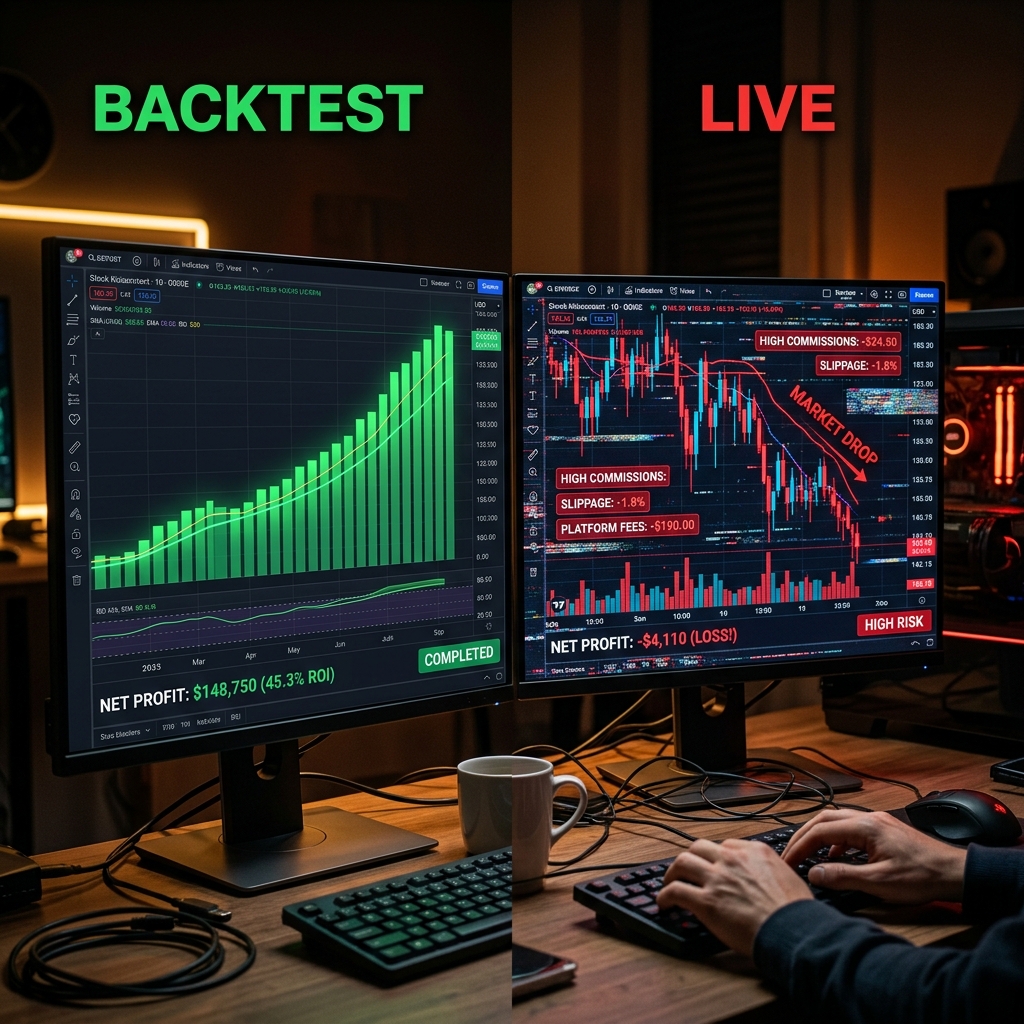
The Hidden Costs of Algorithmic Trading
Every algorithmic trader has experienced this exact scenario: You spend weeks building a strategy. You run it through a historical backtesting engine on TradingView or Python. The equity curve looks like a flawless 45-degree angle to the moon. You've found the holy grail! You deploy it with real capital, go to sleep, and wake up to a decimated account.
What went wrong? Did the market suddenly change overnight? Usually, no. The culprit is a massive disconnect between simulated trading environments and the brutal reality of live order books. This phenomenon is known as the Backtest-Live Divergence.
The 3 Silent Killers of Algorithmic Profitability
1. Slippage: The Illusion of Immediate Execution
In a backtest, when your strategy says "Buy at $60,000," the simulator fills your order instantly at exactly $60,000. It assumes infinite liquidity.
If your high-frequency algorithm relies on making small 0.1% profits per trade, a 0.05% slippage on entry and 0.05% slippage on exit completely destroys your mathematical edge.
2. Maker vs. Taker Fees
Backtesting engines often use a generic, flat fee model (e.g., 0.05% per trade) or worse—no fees at all. Exchanges like Binance or Bybit differentiate between Makers (adding liquidity via limit orders) and Takers (removing liquidity via market orders).
- The Trap: Strategies that rely on market orders (Takers) to guarantee execution pay much higher fees. If you run a Scalping Bot doing 100 trades a day, you aren't just fighting the market; you are bleeding death by a thousand cuts via exchange fees.
3. Over-Fitting (Curve Fitting)
If you torture the data long enough, it will confess to anything. When developing a strategy, it is tempting to tweak parameters (e.g., changing RSI from 14 to 13, MA from 50 to 48) until the backtest graph looks perfect.
You haven't found a universal market law; you have merely built an algorithm that perfectly predicts the past. When deployed on unseen future data, the over-fitted model collapses immediately.
How Mergen Systems Solves the Divergence
To transition from retail disappointment to institutional profitability, you need to abandon naive backtesting. At Mergen Systems, we provide institutional-grade diagnostic tools to bridge the gap.
- Order Book Reconstruction: Our advanced backtest modules do not assume infinite liquidity. We simulate realistic slippage based on historical order book depth data, giving you the real, ugly truth of what your entry price would have been.
- Smart Execution Routing: To combat fees and slippage, our VWAP & TWAP execution algorithms slice large orders into micro-orders, passively entering the market as a Maker to reduce fee drag.
- Walk-Forward Analysis: Our AI avoids over-fitting by utilizing Walk-Forward Optimization—constantly training on past data and validating on out-of-sample data dynamically.
A backtest should not be a marketing tool to make you feel good. It should be a stress-test designed to break your strategy before it breaks your bank account. Stop trading illusions. Start executing reality.