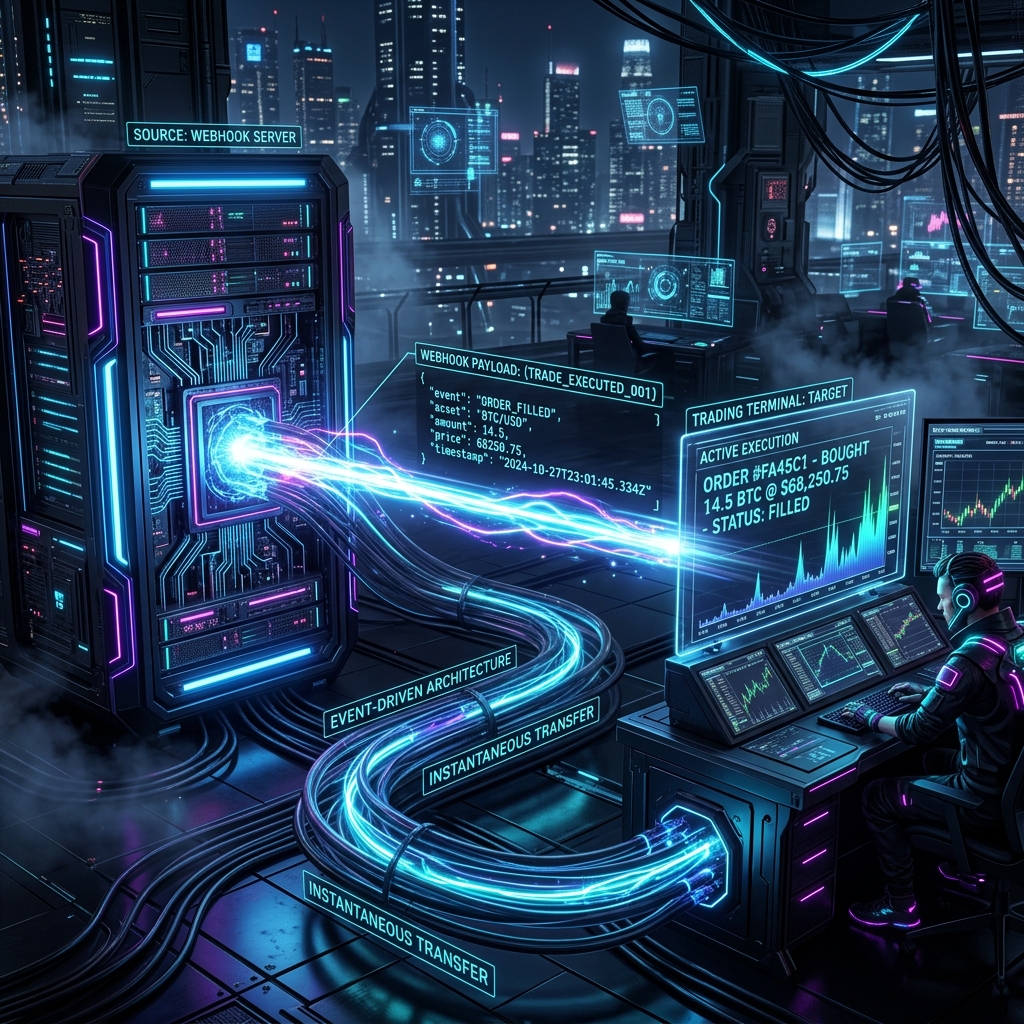
The Latency Problem: Polling vs. Pushing
In algorithmic trading, an execution delay of 100 milliseconds can mean the difference between a highly profitable arbitrage trade and buying the absolute top of a wick. To achieve instantaneous execution, the architecture of how servers communicate is critical.
Traditional APIs use a Polling architecture. Imagine a trader constantly asking a server, "Is there a signal yet? No? How about now? No? How about now?" This is highly inefficient. It wastes CPU cycles, hits rate limits, and most importantly, introduces latency. If the server says "Yes" right after you asked, you won't know until your next scheduled question.
Enter the Webhook: Event-Driven Architecture
A Webhook flips the communication model upside down. Instead of the client constantly asking the server for updates, the client simply provides the server with a URL (a "hook") and says, "Don't talk to me. Just send data to this URL the exact millisecond an event happens."
This is known as an Event-Driven Architecture. It is a "Push" mechanism rather than a "Pull" mechanism.
GENERATOR
ENGINE
The Anatomy of a Webhook Payload
When an indicator crosses or an AI model detects a pattern, the Signal Generator instantly fires an HTTP POST request to the Execution Engine's Webhook URL. This request contains a JSON payload (the "Action").
{
  "timestamp": "2026-06-28T14:02:05.123Z",
  "symbol": "BTCUSDT",
  "action": "LONG",
  "leverage": 10,
  "auth_token": "x8f9a2b4..."
}
Security: The Dark Side of Webhooks
Because Webhook URLs are publicly accessible on the internet, they are highly vulnerable to Replay Attacks and Malicious Injections. If a hacker finds your Webhook URL, they can send a fake "Sell Everything" payload to your trading bot. Institutional Webhook systems secure this via HMAC (Hash-based Message Authentication Code) signatures. The payload is cryptographically signed by the sender, and the receiver verifies the signature before executing the trade.
Conclusion
Webhooks are the nervous system of modern algorithmic trading. By adopting an Event-Driven "Push" architecture, quantitative systems eliminate polling latency, ensuring that trades are executed the exact microsecond the algorithmic condition is met. In the digital matrix of finance, speed is not just an advantage; it is survival.