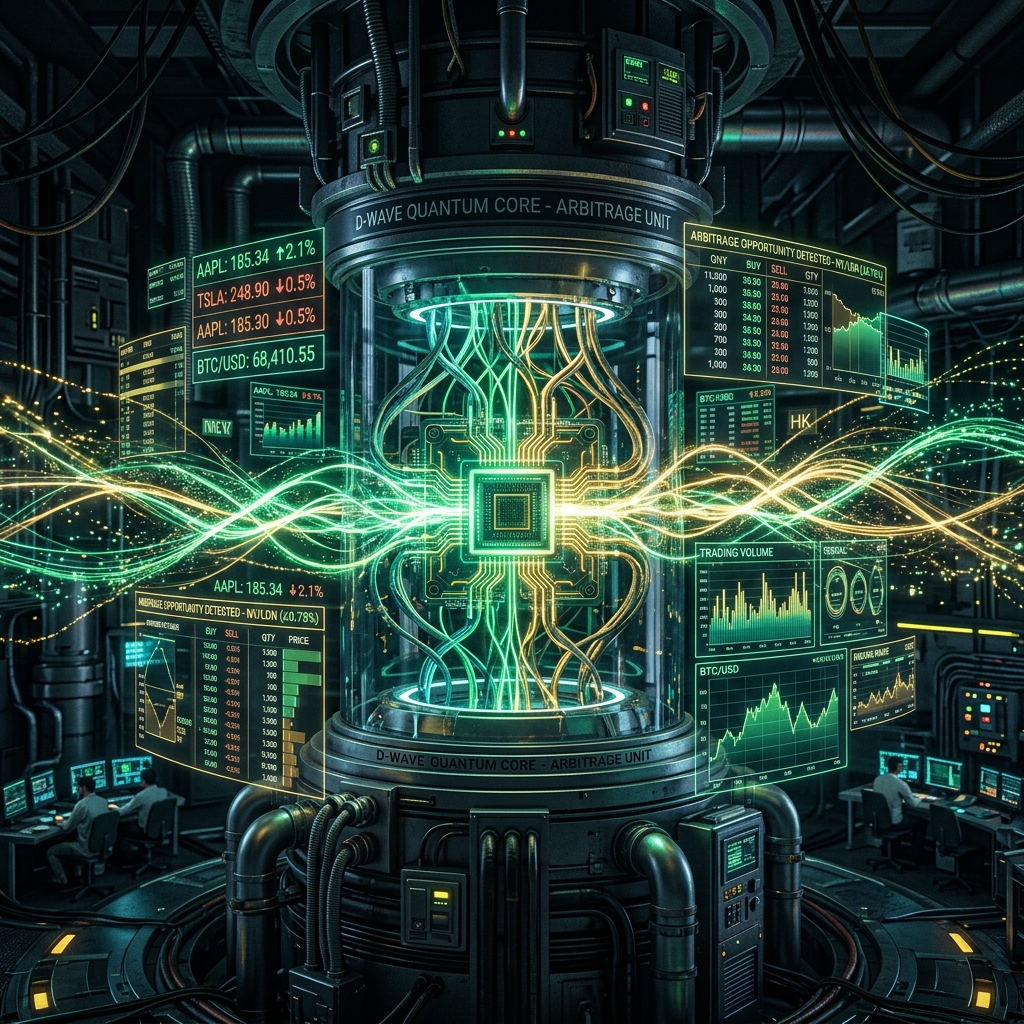
The Limits of Classical Silicon
In modern High-Frequency Trading (HFT), the war for alpha is fought in microseconds (millionths of a second). Firms spend hundreds of millions of dollars to lay fiber-optic cables through mountains just to shave 3 milliseconds off the transmission time between Chicago and New York. However, classical computing is hitting a physical wall. A traditional CPU processes information linearly as 1s and 0s. When scanning 500 different cryptocurrency exchanges for arbitrage opportunities, a classical computer must calculate the combinations sequentially.
The next frontier of algorithmic dominance is Quantum Computing.
Qubits and Superposition Arbitrage
Unlike classical bits, Quantum bits (Qubits) can exist in a state of Superposition—meaning they can be both 1 and 0 simultaneously. Why does this matter for trading?
Imagine a Triangular Arbitrage opportunity involving BTC, ETH, and SOL across Binance, Coinbase, and Kraken. To find the single most profitable routing path, a classical computer must calculate Path A, then Path B, then Path C. As the number of assets and exchanges grows, the number of possible combinations explodes exponentially into the millions. By the time the classical CPU finds the best path, the order book has already changed.
A Quantum algorithmic execution engine does not calculate paths sequentially. Through superposition, it evaluates every single possible arbitrage route simultaneously. It collapses the quantum state to instantly reveal the globally optimal path in zero time. This is not just an optimization; it is a fundamental breaking of the classical speed limit.
Quantum Annealing and Portfolio Optimization
Beyond simple arbitrage, quantum processors like those developed by D-Wave are specifically designed for complex optimization problems. Portfolio Rebalancing is essentially a massive optimization equation: How do we maximize returns while minimizing risk across 10,000 different assets with constantly shifting correlations?
Classical "Monte Carlo" simulations run 10,000 random paths to guess the best portfolio. A Quantum Annealer maps the portfolio risk landscape as an energy field and instantly settles into the "lowest energy state"—which corresponds to the mathematically perfect portfolio allocation.
The Threat: Quantum Decryption
While Quantum AI offers unprecedented profit potential, it also poses an existential threat to global finance. If a proprietary trading firm develops a sufficiently powerful quantum computer, they could theoretically use Shor's Algorithm to break the RSA encryption that secures the world's banking systems and blockchains.
This is why forward-thinking platforms are already investigating Post-Quantum Cryptography. To survive the next decade, algorithmic trading infrastructure must be quantum-resistant, ensuring that execution APIs and user wallets cannot be mathematically brute-forced by a quantum adversary.
Conclusion
We are currently in the "dial-up internet" phase of Quantum Trading. However, the theoretical groundwork is already complete. The firms that first successfully integrate quantum co-processors into their neural networks will achieve an arbitrage advantage so absolute, it will render all classical high-frequency trading algorithms obsolete overnight.