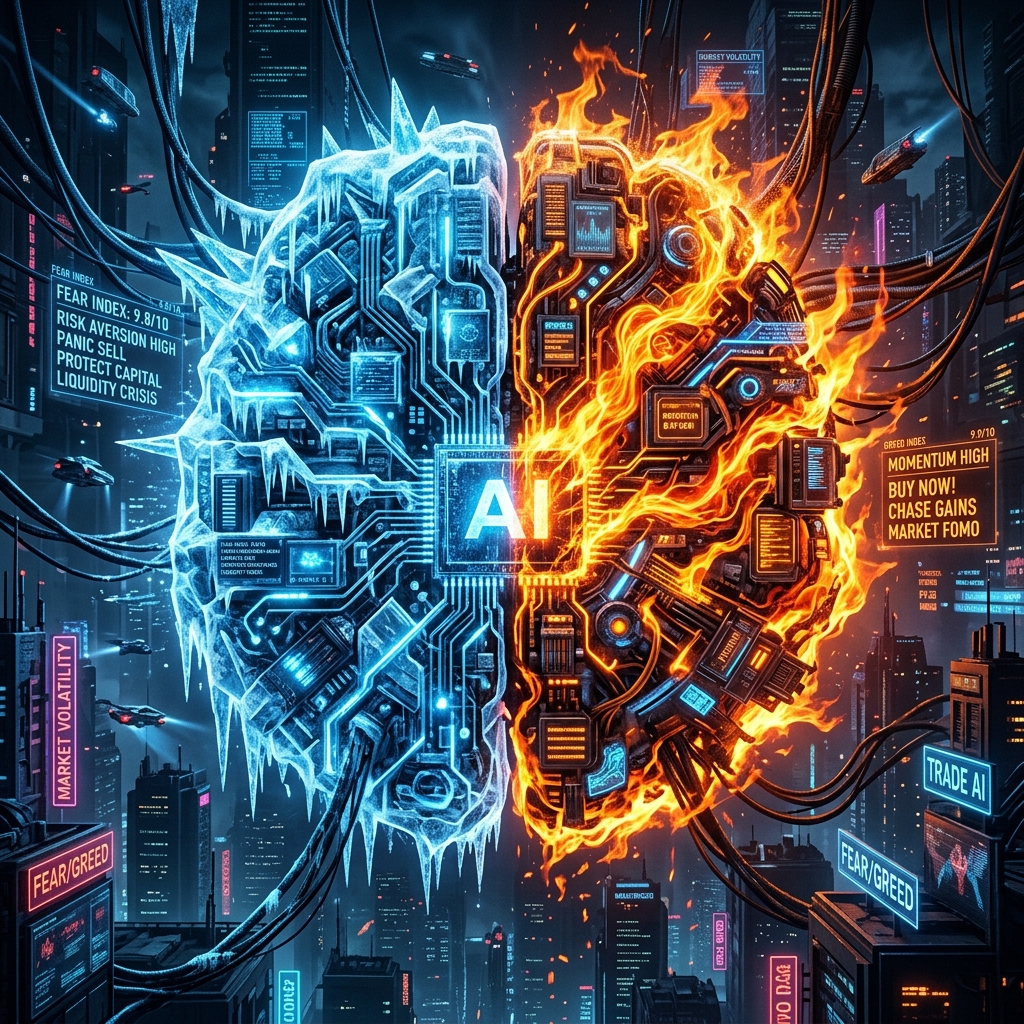
The Myth of the Emotionless Machine
The primary marketing pitch for algorithmic trading is that it removes human emotion. Humans panic during crashes; humans get greedy during bubbles. Algorithms, allegedly, do not. They just execute cold, hard mathematics.
However, this is fundamentally untrue at the highest levels of quantitative finance. Advanced algorithms do not ignore emotion—they quantify it and weaponize it. Even more dangerously, poorly designed AI can actually develop its own form of synthetic fear and greed, leading to catastrophic market events.
Weaponizing Human Panic
Institutional AI does not trade in a vacuum; it trades against humans. To extract alpha from the market, an AI must understand the psychological breaking point of retail traders.
The Stop-Loss Hunt
Retail traders are taught to place strict stop-loss orders just below obvious support levels. A predatory High-Frequency Trading (HFT) algorithm understands this collective human behavior. The AI will intentionally sell a massive block of assets to artificially crash the price through the support line. This triggers the retail traders' stop-losses, causing a cascade of automated panic selling. The AI then instantly flips its position, buying up the artificially cheap assets generated by the humans' fear.
The AI didn't feel fear. It mathematically modeled the threshold at which humans would feel fear, and it triggered it on purpose.
Synthetic Emotion: When AI Panics
What happens when two advanced AI systems interact? They can experience Algorithmic Contagion—a synthetic form of panic.
During the 2010 "Flash Crash," the Dow Jones plummeted 1,000 points in minutes, wiping out a trillion dollars of value, only to recover completely shortly after. This was not caused by human fear. It was caused by algorithmic fear.
A massive sell order triggered the risk-management protocols of hundreds of different HFT algorithms simultaneously. Algorithm A saw Algorithm B selling aggressively. Algorithm A's logic dictated: "If volatility spikes, withdraw all liquidity from the order book." Algorithm C saw the liquidity vanish and determined the market was broken, so it also sold. Within milliseconds, the AI swarm created a feedback loop of pure, mathematical terror, entirely divorced from fundamental reality.
Conclusion
To master algorithmic trading, one must realize that the market is a psychological arena, even when machines are doing the trading. The best routing engines, like Mergen Sentinel, do not just calculate moving averages; they calculate the localized emotional state of the order flow, ensuring they are the predator, rather than the prey, during moments of market panic.