The Problem with Holding
In traditional investing, the most common advice is to "HODL" (Hold On for Dear Life). While holding fundamentally strong assets long-term can be profitable, it is mathematically inefficient. If you construct a portfolio of 50% Bitcoin and 50% Ethereum, and Ethereum suddenly surges 200% in value, your portfolio is now dangerously skewed. It might become 20% Bitcoin and 80% Ethereum. You are now massively overexposed to a single asset that is statistically due for a correction.
What is Portfolio Rebalancing?
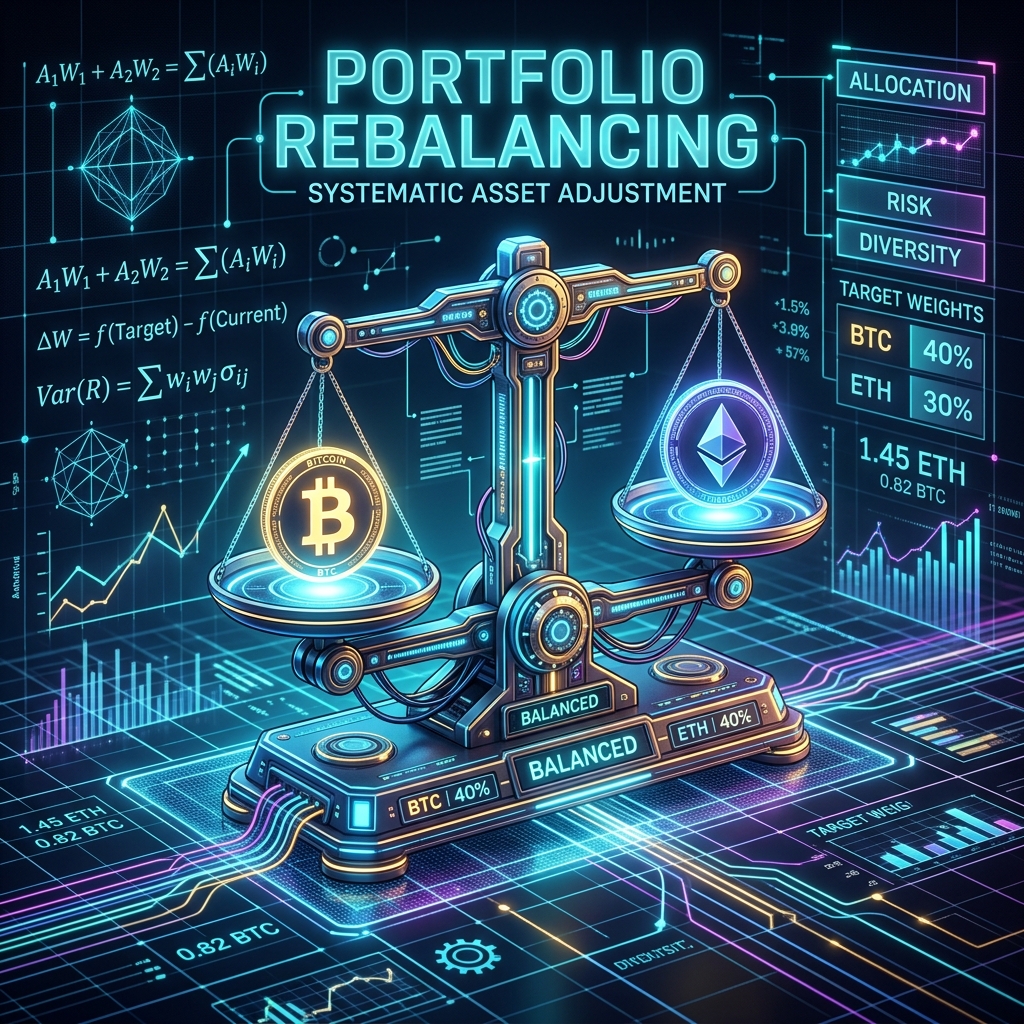
Portfolio Rebalancing is the act of realigning the weightings of your portfolio of assets. It involves periodically buying or selling assets to maintain your original or desired level of asset allocation.
Let's return to the 50/50 BTC/ETH example. If you start with $10,000 total ($5k BTC, $5k ETH), and ETH pumps, your portfolio might now be $5k BTC and $15k ETH (Total $20,000). Your allocation is now 25% BTC and 75% ETH.
To rebalance back to 50/50, you must:
- Sell $5,000 worth of ETH (locking in profits from the high).
- Buy $5,000 worth of BTC (buying the underperforming asset at a relative low).
Both assets now sit at $10,000 each. You have successfully locked in gains from the asset that pumped and accumulated more of the asset that didn't, perfectly executing the legendary "Buy Low, Sell High" mantra.
Threshold vs. Time-Based Rebalancing
There are two primary ways to trigger a rebalance:
- Time-Based: Rebalancing every week, month, or quarter regardless of price action. This is common in traditional 401(k) accounts but is often too slow for the hyper-volatile crypto market.
- Threshold-Based (Tolerance Bands): Rebalancing only when an asset deviates by a specific percentage. For example, setting a 5% threshold means if BTC drops to 44% of the portfolio (a 6% deviation from the 50% target), the system instantly triggers a rebalance. This is far superior for capturing flash crashes and sudden pumps.
Conclusion
Rebalancing removes the stress of trying to time the market. Instead of predicting which coin will pump next, you simply construct a diversified basket and let mathematical equilibrium generate yield while reducing your overall volatility footprint.