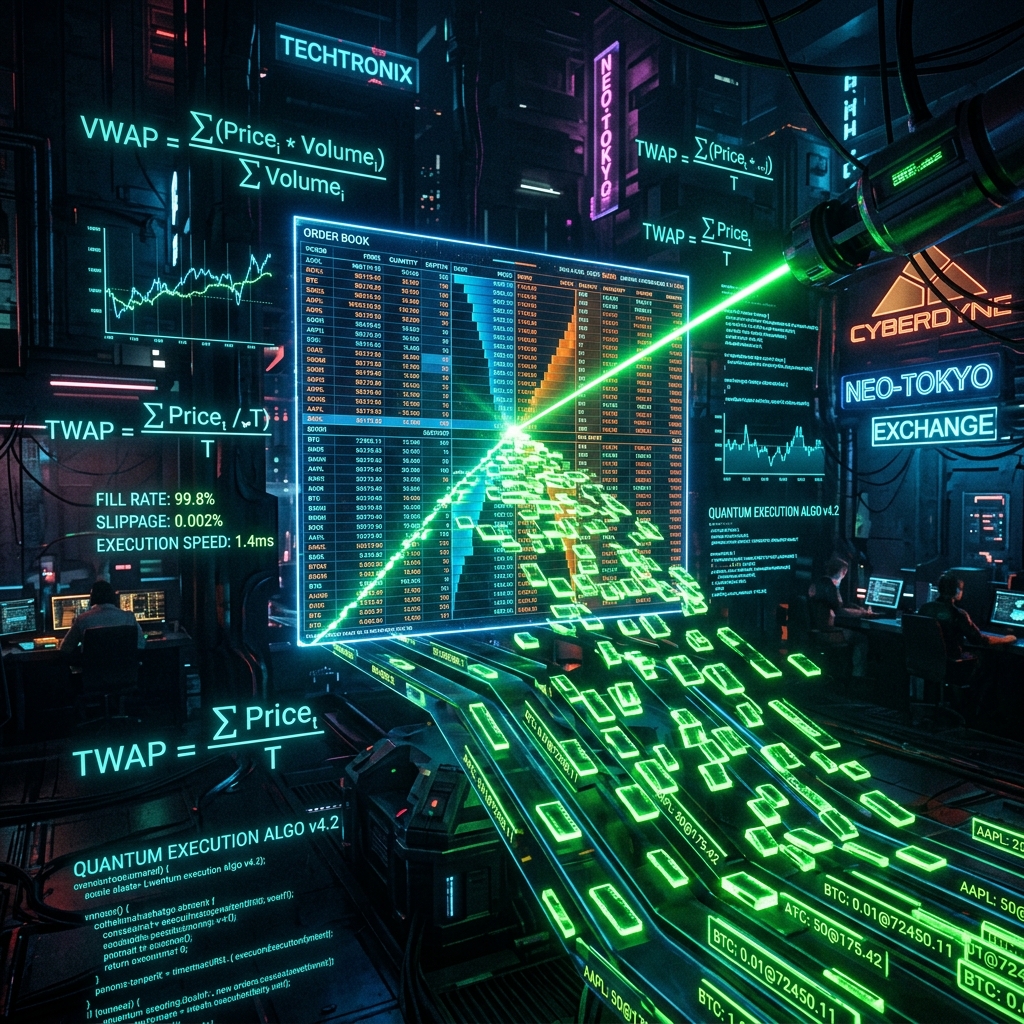
The Whale's Dilemma
Retail traders have a luxury that institutional traders do not: Infinite Liquidity. If a retail trader wants to buy 1 Bitcoin, they simply click "Buy," and the order fills instantly at the current price. However, if a massive hedge fund wants to buy 5,000 Bitcoin, they cannot just click "Buy." If they submit a single market order, they will instantly consume the entire order book, causing the price to skyrocket violently. This is known as Slippage or Market Impact. By the time their final Bitcoin is purchased, they might be paying 10% above the initial price.
To solve this, institutions use highly advanced AI Execution Algorithms. The goal is no longer about what to buy, but how to buy it without the rest of the market noticing.
Beyond Static VWAP
Historically, the solution to the Whale's Dilemma was VWAP (Volume-Weighted Average Price) and TWAP (Time-Weighted Average Price). A static TWAP algorithm would simply take the 5,000 BTC order, divide it by 24 hours, and blindly execute a small piece every few minutes.
The problem with static TWAP/VWAP is predictability. High-Frequency Trading (HFT) firms quickly realized that if an institution was blindly buying every 5 minutes, they could "front-run" the algorithm. The HFT bot would buy the asset at minute 4:59, wait for the institution's algorithm to execute and push the price up at minute 5:00, and immediately sell it back for a risk-free profit.
To combat this predatory HFT behavior, execution routing has evolved into Dynamic, Machine-Learning VWAP.
Reinforcement Learning Execution
Modern AI execution engines (like the routing cores utilized by tier-1 funds) use Reinforcement Learning to act as invisible snipers. They do not buy on a fixed schedule. Instead, they dynamically analyze the micro-structure of the order book in real-time.
The AI's Tactical Playbook:
- Dark Pool Routing: The AI attempts to route the large blocks to "Dark Pools"—private exchanges where the order book is hidden, preventing front-running.
- Liquidity Seeking: Instead of buying on a schedule, the AI waits in ambush. It monitors the tape for a massive sell order from another participant. The millisecond the sell order hits the book, the AI absorbs it instantly, filling its buy quota without moving the price.
- Stochastic Randomization: The AI randomizes its order sizes and intervals. It might buy 2.4 BTC at 10:01:03, wait 17 seconds, buy 0.8 BTC, wait 3 minutes, then buy 5 BTC. By randomizing its footprint, the AI makes it impossible for predatory algorithms to detect that a whale is accumulating.
Conclusion
In the institutional realm, generating a profitable trading signal is only 50% of the battle. The other 50% is executing that signal. Machine Learning execution algorithms act as the ultimate stealth technology, allowing multi-billion dollar portfolios to maneuver through the financial markets like ghosts, leaving absolutely zero footprint.