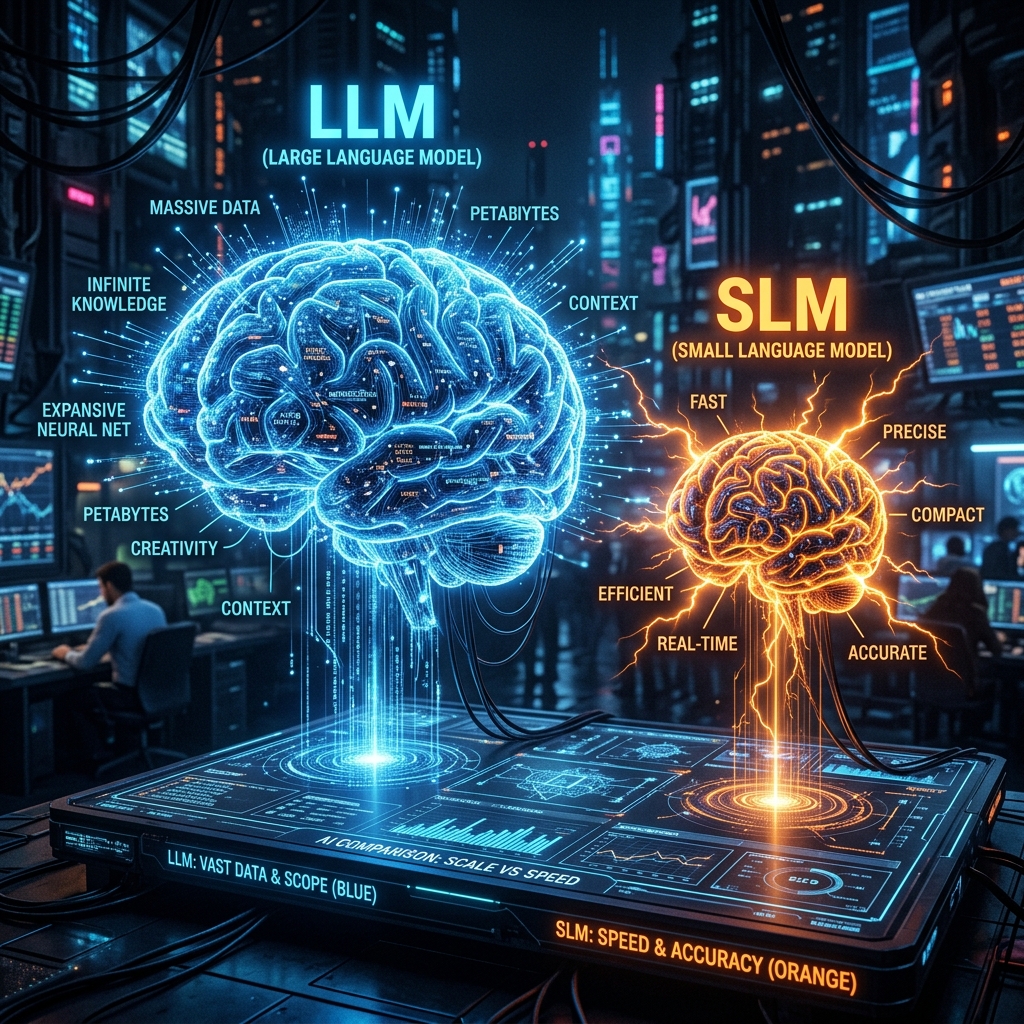
The AI Arms Race in Finance
The financial markets are currently undergoing the most significant technological revolution since the transition from paper trading floors to electronic exchanges. Artificial Intelligence is no longer a buzzword; it is the core execution engine of modern liquidity. However, a profound architectural debate has emerged among quantitative developers and institutional traders: Should we rely on massive, general-purpose Large Language Models (LLMs) or hyper-specialized Small Language Models (SLMs)?
To understand the future of algorithmic trading, we must dissect the fundamental differences in their architecture, latency footprints, and specific financial applications.
The Heavyweight: Large Language Models (LLMs)
Params: 100B - 1T+ Latency: High (500ms+) Scope: General Omniscience
Large Language Models, such as GPT-4 or Claude 3 Opus, are the titans of the AI world. They are trained on virtually the entire corpus of human knowledge available on the internet. Their neural networks contain hundreds of billions, or even trillions, of parameters.
The Advantage: Deep Contextual Synthesis
In finance, an LLM excels at Macro-Economic Synthesis and complex fundamental analysis. If you feed an LLM a 500-page SEC 10-K filing, a transcript of the Federal Reserve Chairman's latest speech, and a dozen geopolitical news reports, it can instantly connect the dots.
For example, an LLM can understand that a localized strike at a copper mine in Chile, combined with a hawkish stance from the ECB, might create a unique supply bottleneck affecting European electric vehicle manufacturers. This level of semantic understanding and cross-domain reasoning is currently impossible for any other system to achieve.
The Disadvantage: The Latency Trap
Despite their brilliance, LLMs suffer from a fatal flaw in algorithmic trading: Latency. Generating a response from a 1-trillion parameter model takes time. Even highly optimized API calls often require 500 milliseconds to 2 seconds to return an answer.
In high-frequency trading (HFT) or even medium-frequency scalping, 500 milliseconds is an eternity. By the time the LLM has formulated the perfect trading thesis based on a breaking news headline, the high-frequency algorithms (which operate in microseconds) have already moved the market, destroying the arbitrage opportunity. Furthermore, deploying LLMs locally requires massive GPU clusters, making them prohibitively expensive for real-time tick analysis.
The Precision Scalpel: Small Language Models (SLMs)
Params: 1B - 7B Latency: Ultra-Low (<10ms) Scope: Hyper-Specialized
Small Language Models represent the cutting-edge philosophy in quantitative finance. Instead of trying to build a "God AI" that knows everything from Shakespeare to quantum physics, quant teams build SLMs. These models have only 1 to 7 billion parameters, but they are trained exclusively on financial data.
The Advantage: Microsecond Execution
Because an SLM is drastically smaller, its computational footprint is tiny. It can run locally on edge devices or standard server architecture without requiring multi-million dollar GPU farms. More importantly, its inference time (the time it takes to make a decision) is measured in single-digit milliseconds.
The Mergen Sentinel AI utilizes SLM architecture. When a major crypto exchange goes down or the SEC posts a sudden tweet, the SLM doesn't waste time trying to write a beautiful essay about it. It instantly classifies the text as [EXTREME BEARISH] and routes an emergency kill-switch command to the `StrategyEngine.Core` to dump all open long positions. This happens before the human eye can even finish reading the headline.
Specialized Training: The Order Book Oracle
SLMs can be trained on non-linguistic sequence data, such as Level-2 Order Book dynamics. A 3-Billion parameter SLM can be fed decades of tick-by-tick order book data. It learns the exact mathematical "shape" of a market about to flash-crash. It doesn't know what a stock is, it doesn't know who the President is—it only knows the highly complex, multi-dimensional patterns of supply and demand clustering in the order book.
The Hybrid Future: Symbiotic Architecture
The ultimate trading system does not choose between LLMs and SLMs; it orchestrates them in a symbiotic architecture. This is the holy grail of institutional design.
- The LLM as the Portfolio Manager: The massive LLM runs on a daily or weekly loop. It reads global news, analyzes macro trends, and dictates the overall risk exposure. It tells the system: "The macro environment is highly volatile; reduce overall leverage to 2x and bias towards shorting technology assets."
- The SLM as the Execution Sniper: The SLMs run on a sub-millisecond loop. They don't care about the macro environment. They take the parameters set by the LLM (e.g., "Find short opportunities") and scan the live order book streams. When the exact micro-pattern aligns, the SLM pulls the trigger instantly.
Conclusion
As retail traders gain access to more sophisticated tools, understanding the architectural differences between massive semantic engines and hyper-specialized neural snipers is crucial. While LLMs capture the headlines with their conversational prowess, it is the lightning-fast, purpose-built SLMs that are quietly capturing the majority of alpha in the algorithmic trenches.