The Physics of Liquidation
Leverage is a magnifying glass. It amplifies your returns, but it also amplifies your risk of systemic failure. When a trader opens a leveraged position, they must provide collateral (margin) to the exchange. But how the exchange handles that collateral defines whether a bad trade costs you a small penalty, or entirely wipes out your life savings.
There are two primary architectures for collateral management: Isolated Margin and Cross Margin. Understanding the deep mathematics between these two is the first step separating retail gamblers from institutional quantitative analysts.
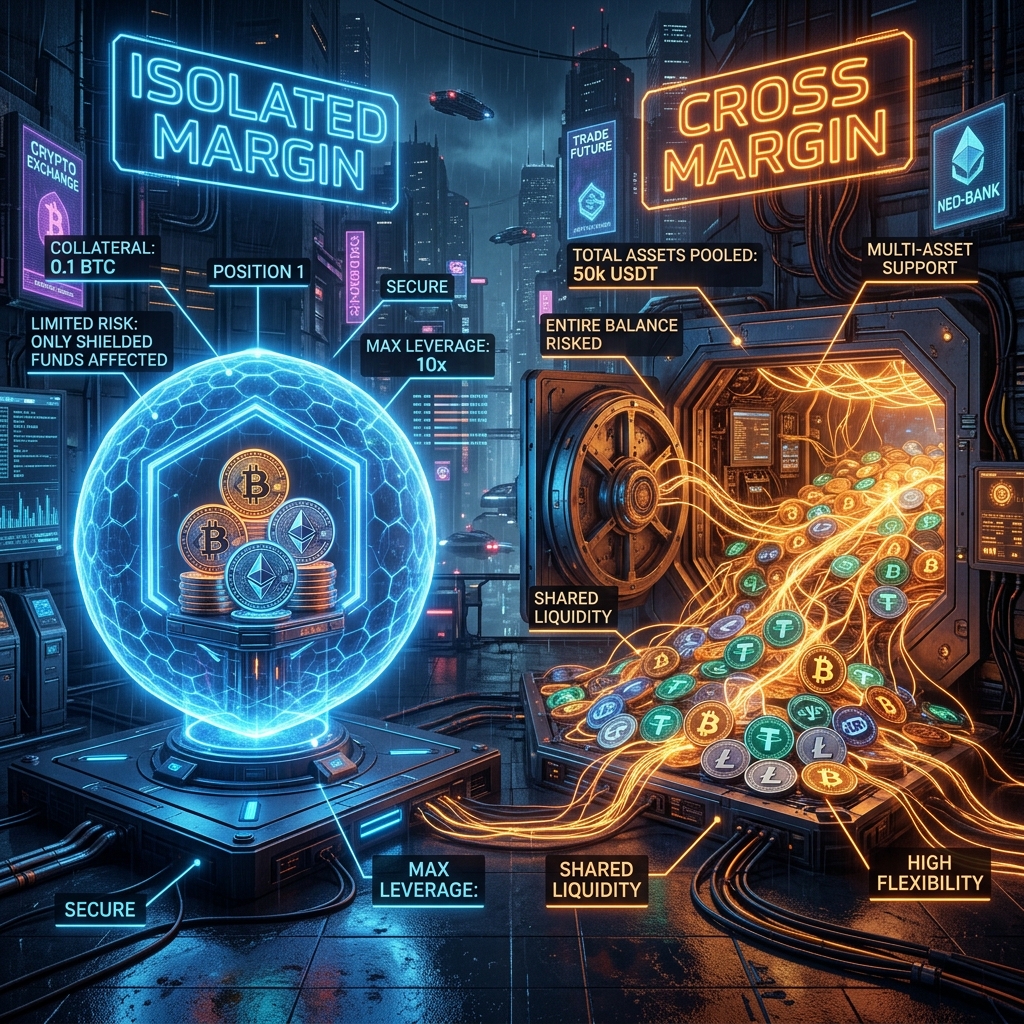
Isolated Margin: The Quarantine Zone
In Isolated Margin, the capital you allocate to a specific trade is mathematically "quarantined" from the rest of your wallet. It is locked inside a digital shield.
Scenario A: The Isolated Wallet ($10,000 Balance)
You have $10,000 in your Futures Wallet. You decide to go LONG on Bitcoin. You allocate $1,000 to the trade and use 10x Leverage.
- Initial Margin: $1,000
- Position Size (Notional): $10,000 (10x Leverage)
- Available Wallet Balance: $9,000 (Safe behind the firewall)
The Catastrophe: Bitcoin suddenly crashes by 10%. Your $10,000 position loses $1,000. Because your Initial Margin was exactly $1,000, your collateral is completely wiped out. The exchange triggers a Liquidation Engine. Your position is forcefully closed. The $1,000 is gone forever.
The Aftermath: Even though the trade exploded, the explosion was contained inside the shield. You check your wallet, and your remaining $9,000 is perfectly safe. Isolated margin protects your systemic capital from singular catastrophic events.
Cross Margin: The Interconnected Matrix
In Cross Margin, there are no shields. The exchange looks at your entire wallet balance and uses it as one massive, shared pool of collateral for every single trade you have open. This pushes your liquidation price much further away, but it exposes everything to total annihilation.
Scenario B: The Cross Wallet ($10,000 Balance)
You have the same $10,000 in your Futures Wallet. You go LONG on Bitcoin, again allocating $1,000 at 10x Leverage.
- Initial Margin: $1,000
- Position Size (Notional): $10,000
- Total Maintenance Margin Pool: $10,000
The Catastrophe: Bitcoin crashes by 10%. Your position loses $1,000. In Isolated, you would be liquidated immediately. But in Cross, the exchange says: "Wait, he lost $1,000, but he still has $9,000 sitting idle in his wallet. Let's automatically pull money from his wallet to keep the trade alive."
Your trade stays open. But Bitcoin keeps crashing. It crashes by 50%. Your trade is now at a negative PnL of -$5,000. The exchange has silently drained $4,000 from your available balance to cover the floating loss. You refuse to close the trade.
Bitcoin crashes by 100% (or a "flash crash" wick). Your floating loss hits -$10,000. The liquidation engine finally triggers. Because your entire wallet was interconnected to this single bad trade, the exchange forcefully closes the position and drains every last penny.
The Aftermath: Your wallet balance is $0.00. Total systemic failure.
Which is Better? The Quant's Perspective
Retail traders often use Cross Margin because they hate being liquidated by small wicks, unaware that they are risking total bankruptcy. Quantitative hedge funds and algorithmic systems overwhelmingly prefer Isolated Margin combined with strict hard Stop-Loss orders.
By using Isolated Margin, the algorithm defines the maximum possible loss per trade at the exact moment of execution. The math is deterministic. In algorithmic architecture, predictability is power, and uncertainty is death.