The Blind Spot of Traditional Analysis
If you are analyzing Apple's stock ($AAPL), traditional models tell you to look at Apple's P/E ratio, its revenue growth, and its technical chart patterns. But what if a microscopic semiconductor factory in Taiwan unexpectedly burns down? Apple's chart won't show the damage until weeks later when they miss their earnings report. By then, the stock will gap down, and you will lose money.
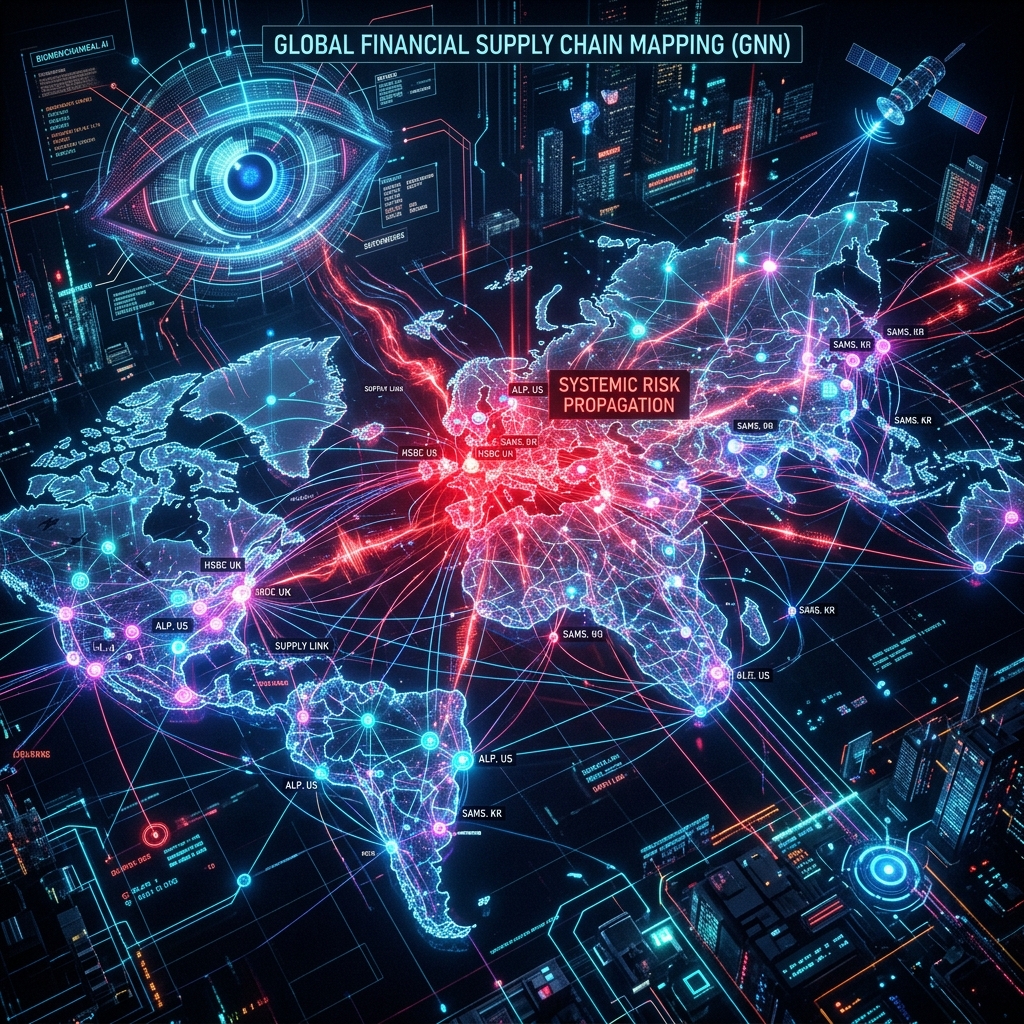
To predict the future, you cannot look at companies in isolation. The global economy is a massive, interconnected web of dependencies. Welcome to the frontier of Graph Neural Networks (GNNs).
Mapping the Economic Matrix
A Graph Neural Network is a specialized AI architecture designed entirely to process relationships. In a financial GNN, every company is a "Node," and every supply chain contract, customer relationship, or geopolitical tie is an "Edge."
Systemic Risk Propagation
When the GNN detects a negative catalyst at a tier-3 supplier (e.g., a localized strike at a lithium mine in South America), the AI doesn't just short the mining company. It calculates the mathematical propagation of the shockwave through the entire global graph.
The AI instantly knows that the mine supplies a battery factory in China, which supplies Tesla, which affects the revenues of a specific shipping conglomerate. The GNN can calculate the exact cascading probability of earnings misses across 50 different companies worldwide within milliseconds of the initial news breaking.
Finding Hidden Alpha
GNNs are not just used for risk management; they are the ultimate tool for finding hidden alpha (excess returns).
If a major cloud computing provider announces a massive, unexpected surge in data center expansion, human analysts will rush to buy the cloud provider's stock. But the GNN has already mapped the exact obscure, small-cap companies that manufacture the specialized cooling systems required for those data centers. The AI executes long positions on the downstream beneficiaries before human analysts even figure out who the suppliers are.
Conclusion
The financial market is not a list of isolated ticker symbols; it is a living, breathing organism of interconnected data. Graph Neural Networks allow institutional quant funds to see the invisible nervous system of the global economy, predicting the ripple effects of every macroeconomic event long before they manifest on a traditional stock chart.