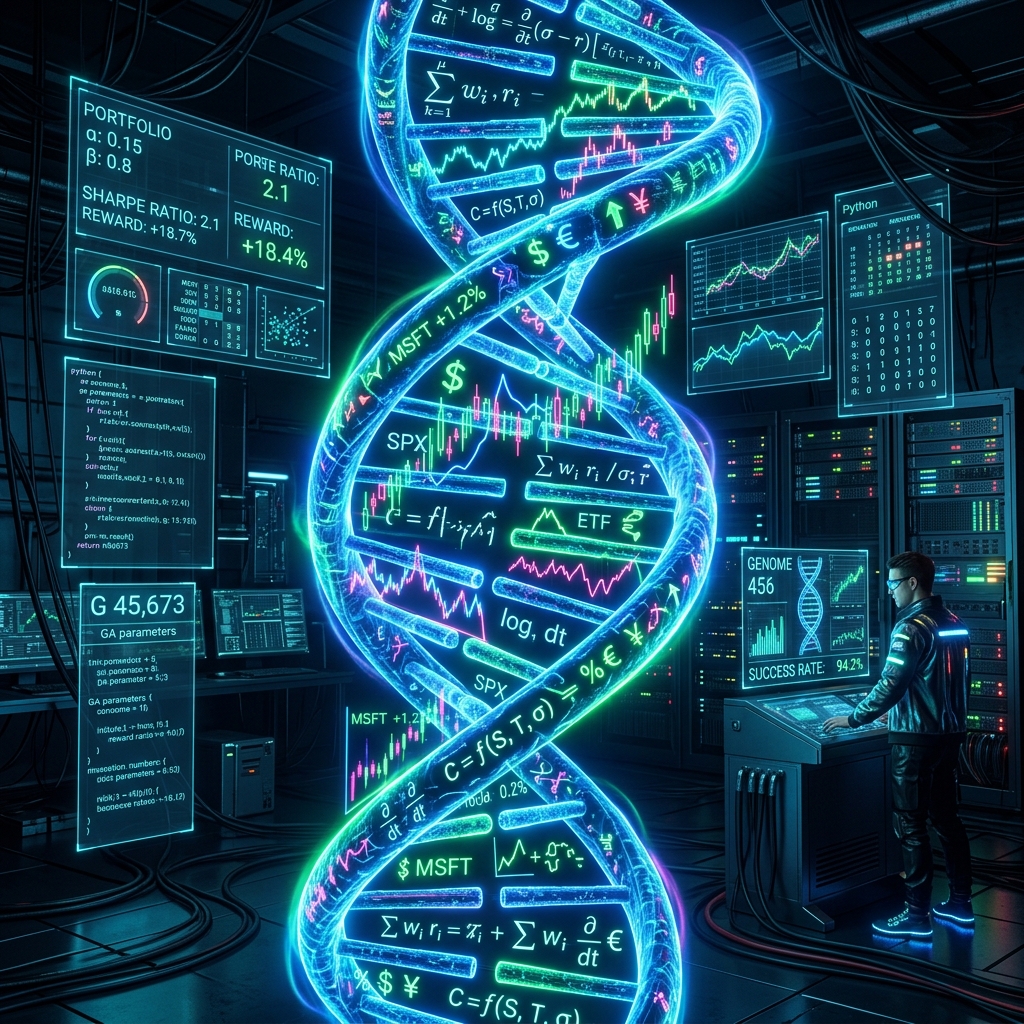
The Limits of Markowitz
Harry Markowitz won a Nobel Prize for Modern Portfolio Theory (MPT), which uses the "Efficient Frontier" to find the optimal balance of risk and reward. However, MPT relies on historical covariance. If you have 500 stocks, calculating the covariance matrix requires solving for 125,000 combinations. If you add dynamic position sizing, transaction costs, and tax implications, the math becomes NP-Hard. A traditional supercomputer would take billions of years to calculate the absolute "perfect" portfolio.
To solve NP-Hard problems, AI engineers don't use brute-force mathematics. They use Biology. They use Genetic Algorithms (GAs).
Breeding the Alpha Portfolio
A Genetic Algorithm simulates the process of Darwinian natural selection inside a computer. Instead of animals, the "population" consists of randomly generated trading portfolios.
1. Initialization (The Primordial Soup)
The AI randomly generates 10,000 different portfolios. Portfolio A might be 90% TSLA and 10% Cash. Portfolio B might be 5% across 20 random commodities. These are our "Chromosomes."
2. The Fitness Function (Survival)
The AI runs a 10-year backtest on all 10,000 portfolios. It evaluates them using a Fitness Function (e.g., highest Sortino Ratio). The worst 9,000 portfolios are "killed off" and deleted from memory. The top 1,000 survive.
3. Crossover (Reproduction)
The surviving 1,000 portfolios are mathematically "mated" with each other. If Portfolio A was great at surviving bear markets, and Portfolio B was great at capturing bull runs, the AI splices their parameters together to create a "child" portfolio that inherits the best traits of both parents.
4. Mutation (The Black Swan Defense)
If you only breed the same survivors, the gene pool stagnates. The AI randomly introduces Mutations—changing a 5% allocation in Gold to a 5% allocation in Volatility Index (VIX) calls. Most mutations fail and are killed in the next generation, but occasionally, a mutation discovers a brilliant, non-obvious hedge against a Black Swan event.
Evolution in Real-Time
A modern Genetic Algorithm loops through this birth-death-reproduction cycle 1,000 times per second. By the time it reaches Generation 500,000, it has evolved a highly complex, mathematically elegant portfolio that no human quant could have explicitly designed. It naturally "learns" to hedge, take profits, and minimize drawdowns, purely because those traits were required for survival in the simulated environment.
Conclusion
In algorithmic trading, you don't always need to know the mathematical formula for success. Sometimes, you just need to create an environment where failure is punished, and success is allowed to evolve. Genetic Algorithms represent the pinnacle of self-organizing financial artificial intelligence.