Decoding the reality behind algorithmic profitability
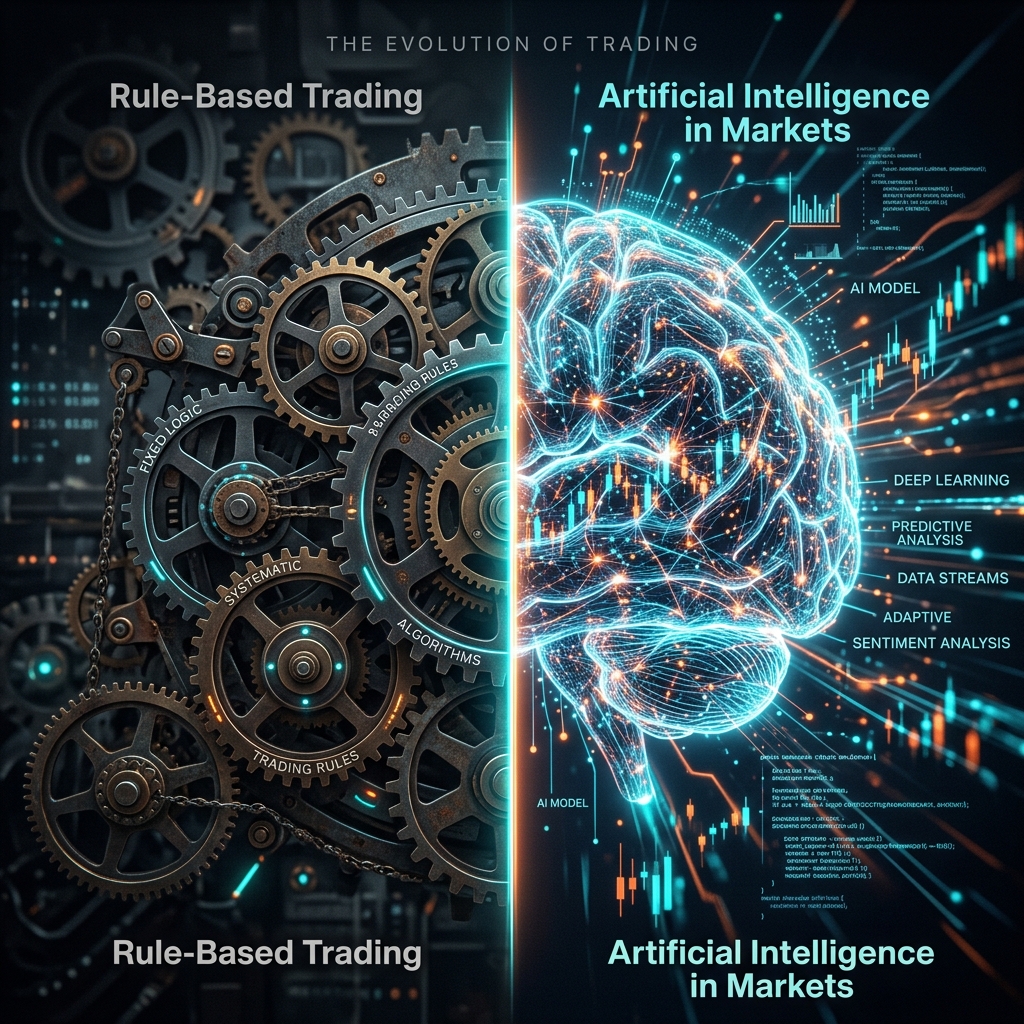
In 2024, the term "AI Trading Bot" is everywhere. From YouTube tutorials promising passive income to aggressive social media campaigns, retail investors are flooded with the idea that algorithms are an infinite money glitch. But when we look under the hood of most commercially available bots, a striking reality emerges: 95% of them are not Artificial Intelligence. They are simple, rigid, rule-based scripts.
To succeed in algorithmic trading, it is absolutely critical to understand the architectural difference between a bot that executes a hardcoded rule and a system that actually learns from the market.
The Anatomy of Rule-Based Trading Bots
A rule-based bot operates on binary logic (If/Then statements). It is a machine executing a predefined script exactly as the developer wrote it.
Strengths of Rule-Based Systems
- Predictability: You know exactly why a trade was taken. There is zero ambiguity.
- Speed: Evaluating a simple mathematical condition takes microseconds.
- Transparency: If the bot loses money, you can look at the code and see exactly which rule failed.
The Fatal Flaw: Market Regime Changes
The problem with rigid rules is that the crypto market is dynamic. A rule-based bot that generates massive alpha during a strong bull trend (like an aggressive Grid Bot) will absolutely decimate your portfolio during a sudden bear market or a low-volatility chop.
A rule-based bot does not "know" the market has changed. It will stubbornly continue executing its "Golden Cross" strategy even when the asset's volatility profile has completely shifted, resulting in a string of devastating stop-outs.
The Paradigm Shift: Artificial Intelligence (Machine Learning)
True AI in quantitative finance, specifically Machine Learning (ML) and Deep Learning (DL), does not follow human-coded trading rules. Instead, it creates its own rules by analyzing vast amounts of historical and real-time data.
When you use an AI architecture like Mergen Sentinel AI, you are not telling the bot to buy when RSI hits 30. You are giving the bot millions of data points (order book depth, historical liquidations, global macro-economic indicators, on-chain data) and letting the neural network find the optimal entry and exit points probabilistically.
Why True AI Outperforms
- Adaptability: An ML model detects regime shifts. It realizes, "Volatility is compressing and order book imbalance is skewing bearish. I should reduce position sizing and avoid long breakouts."
- Non-Linear Patterns: Human indicators (MACD, RSI) are linear and lagging. AI can detect complex, multi-dimensional patterns across hundreds of variables simultaneously that a human eye could never perceive.
- Sentiment Integration: Advanced NLP (Natural Language Processing) models ingest Twitter feeds, news articles, and Federal Reserve meeting transcripts to gauge market sentiment in milliseconds.
The Battle Tested Comparison
| Feature | Rule-Based Bots | True AI (Machine Learning) |
|---|---|---|
| Logic Architecture | Fixed "If/Then" statements | Probabilistic neural networks |
| Market Adaptation | Fails during regime changes | Dynamically adjusts risk parameters |
| Data Processing | Limited to basic price/volume indicators | Ingests unstructured data (On-chain, News, Orderflow) |
| Optimization | Manual backtesting & parameter tweaking | Continuous autonomous learning & weight updating |
The Mergen Advantage: Bridging the Gap
At Mergen Systems, we don't believe in a pure "black-box" approach where traders blindly trust an AI. We believe in Neuro-Symbolic AI—combining the raw, adaptable intelligence of deep learning networks with the strict, unbreakable risk-management rules of traditional algorithms.
While the AI decides when to enter a trade based on multi-dimensional pattern recognition, the Rule-Based engine acts as a Killswitch, enforcing hard stop-losses, maximum drawdown limits, and strict position sizing.
Don't fall for the marketing hype of basic script-bots masquerading as AI. Demand real data science. Demand dynamic adaptability. Demand the future of execution.