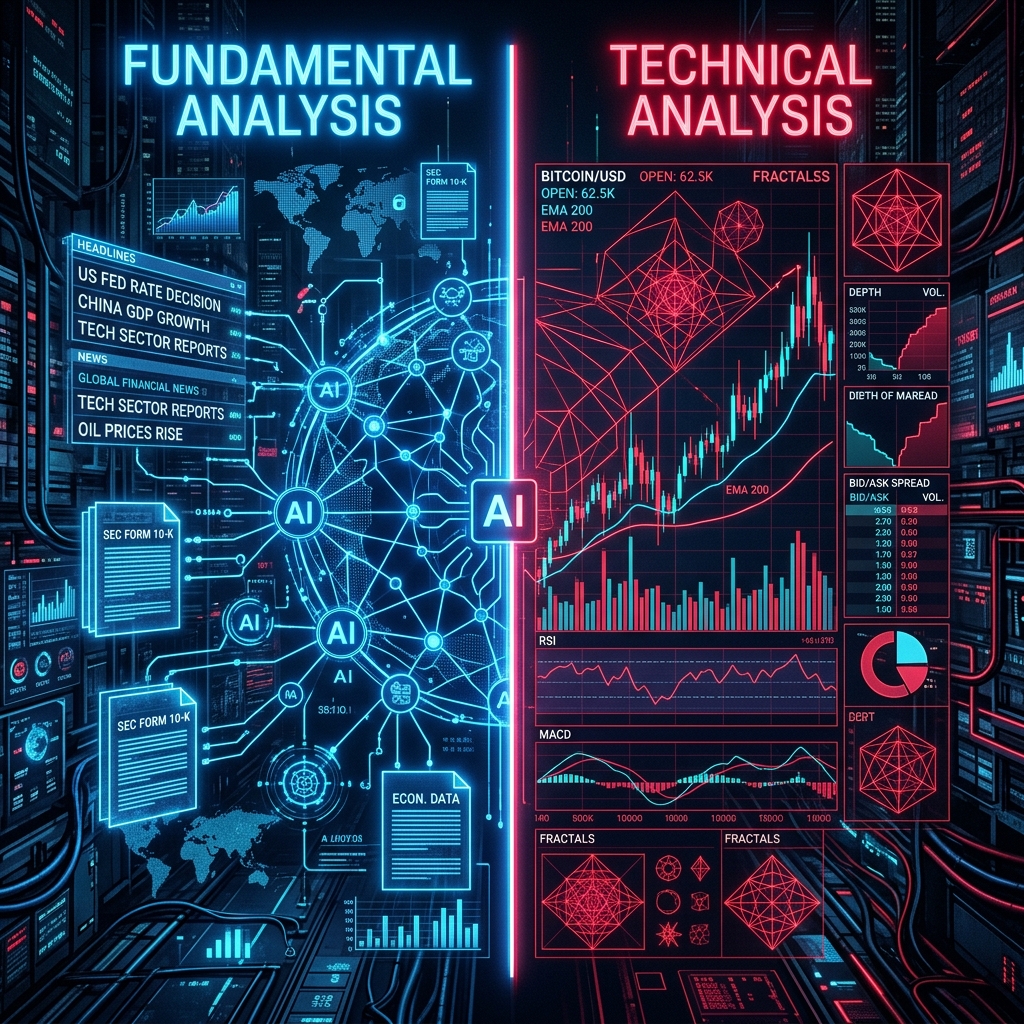
The Two Hemispheres of the Market Brain
In the world of quantitative trading, there are two distinct schools of thought: Fundamental Analysis (the "Why") and Technical Analysis (the "When"). Historically, human traders had to choose one discipline to master. Today, Artificial Intelligence has dominated both, but it does so using completely different mathematical architectures and philosophical approaches.
To build a truly omnipotent algorithmic trading system, one must understand how AI processes these two vastly different universes of data.
Fundamental AI: Decoding the Narrative
Fundamental Analysis is the study of intrinsic value. It requires understanding macroeconomics, supply chain disruptions, geopolitical events, and corporate balance sheets. For a machine, this is the domain of Natural Language Processing (NLP) and Knowledge Graphs.
The Omniscient Reader
A Fundamental AI engine does not look at charts. Instead, it reads the entire internet simultaneously. It consumes SEC Edgar filings, global central bank transcripts, satellite imagery of oil tankers, and millions of X (Twitter) posts in real-time.
When the Federal Reserve releases its meeting minutes, the AI utilizes sentiment analysis to measure the exact "hawkishness" or "dovishness" of the text compared to historical baselines. It builds a semantic Knowledge Graph, instantly calculating how a proposed tariff on semiconductors in Taiwan will impact the quarterly earnings of a specific smartphone manufacturer in California.
The Strategy: Fundamental AI executes Event-Driven trades. It seeks to capture the massive re-pricing of assets that occurs the millisecond new information enters the global narrative.
Technical AI: The Geometry of Chaos
Technical Analysis assumes that all fundamental news is instantly priced into the market, and therefore, the only truth lies in the price action itself. For a machine, this is the domain of Time-Series Forecasting and Pattern Recognition (Convolutional Neural Networks).
The Order Book Assassin
A Technical AI engine doesn't care if a company is bankrupt or if a war has started. It only sees pure mathematics: Volume, Velocity, Order Book Depth, and Volatility Skew. It looks at the market as a massive, multi-dimensional fluid dynamics equation.
Using algorithms like LSTMs (Long Short-Term Memory) or Transformers, the AI detects microscopic geometric fractals in the order flow that precede price jumps. If it detects a specific sequence of rapid bid-cancellations (spoofing) combined with a divergence in the 1-minute MACD histogram, it fires a buy order.
The Strategy: Technical AI executes Statistical Arbitrage and Momentum trades. It seeks to capture the mathematical inefficiencies and psychological panic of other market participants.
The Mergen Synthesis
The fatal flaw of most trading firms is isolating these two engines. A Technical AI might execute a perfect technical breakout, entirely unaware that the CEO just resigned on live television. Conversely, a Fundamental AI might identify an incredibly undervalued asset, but buy it at the absolute worst technical resistance level.
The ultimate frontier—and the core philosophy behind advanced routing engines like Mergen—is Orthogonal Confluence. By merging the narrative omniscience of Fundamental AI with the geometric precision of Technical AI, the algorithm achieves a holistic understanding of the market, generating alpha that is virtually impossible for a human to replicate.